Shopify Expert for Hire: Why Your Store Isn’t Selling (And How to Fix It)
The Most Common Shopify Trap
You launched your Shopify store. The product photos look clean, the description reads well, and you’ve even run a few ads. But the sales? Barely moving. You refresh your dashboard five times a day hoping something changes. It doesn’t.
Why “Live” Doesn’t Mean “Profitable”
Shopify makes it genuinely easy to launch a store. Pick a theme, upload products, connect payments, click publish. What Shopify doesn’t do is teach you how to build a store that converts. There’s a huge gap between “my store is live” and “my store makes money” — and most new brands don’t realize that gap exists until they’ve wasted months and thousands of ad dollars.
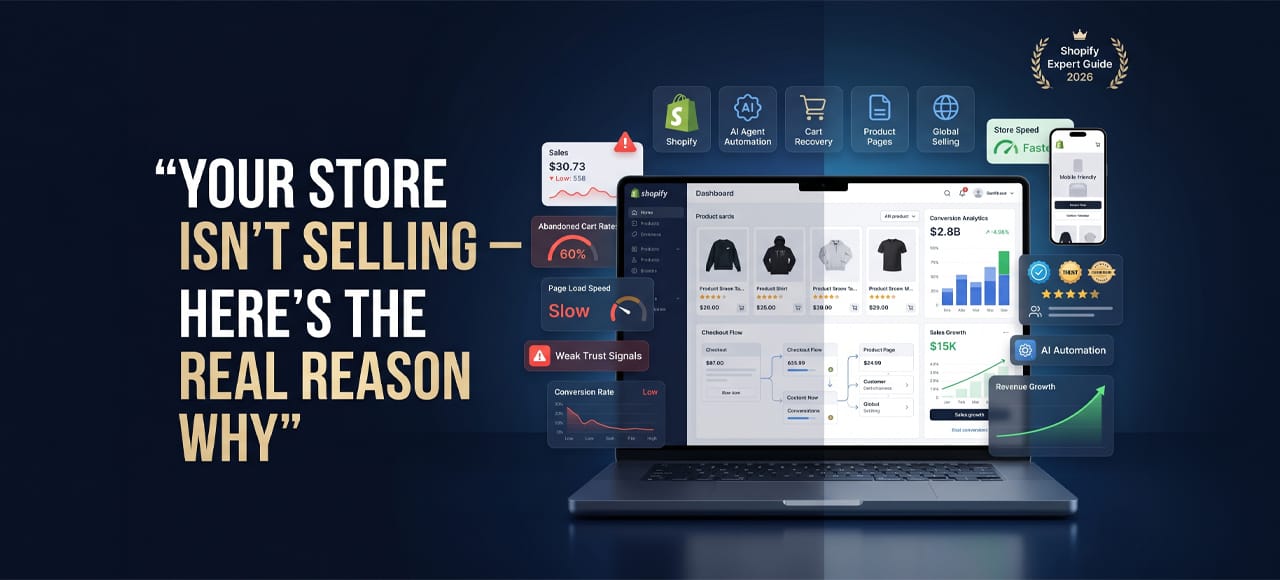
A beautiful store is not the same as a profitable store. Page speed, trust signals, product page layout, mobile experience, checkout friction, email flows — all of these quietly decide whether a visitor buys or clicks away. Most DIY Shopify stores fail on at least four of them.
Why New Brands Keep Struggling
Here’s the honest truth: new brands struggle because nobody ever showed them the right way. They watch a 20-minute YouTube tutorial, copy what the guru did, and end up with a generic-looking store that blends into the thousands of others launching that same week.
What Hiring a Shopify Expert Actually Gets You
When you hire a Shopify expert, you’re not paying for a “pretty website.” You’re paying for someone who has already made the expensive mistakes on other stores and knows exactly what to avoid on yours.
- Pick or customize a lightweight theme that loads fast on mobile
- Design product pages around your strongest selling point
- Remove checkout friction that silently costs you sales every day
- Integrate the right apps — reviews, email, analytics — without bloating your store
- Set you up for multi-region selling with proper currency and language settings
- Hand over a store you can actually manage without calling them every week
The Questions Every Store Owner Should Ask Themselves
Before you even think about hiring, sit down and answer these. They’ll shape every decision that follows:
Where AI Agents Change Everything for Solo Owners
Here’s the part most Shopify experts won’t mention — but it’s becoming the single biggest advantage for small store owners: custom AI agents.
You’re traveling abroad — maybe a weekend trip, maybe a two-week vacation. You’re a solo business owner. An order comes in at 2am your time. Who confirms it? Who creates the shipping label? Who replies when the customer emails about sizing? If you’re doing it all yourself, something always slips — and slipping costs customers.
A custom AI agent handles the entire chain for you. You land, open your phone, and see a clean summary of everything that happened while you were gone. Nothing missed. No customer ignored. No review lost.
Why Shopify Is Still the Best Platform for New Brands
There are a hundred platforms you could use. Here’s why Shopify wins for most brands in 2026:
| Feature | Shopify | Other Platforms |
|---|---|---|
| Page Load Speed | ✅ Fast out of the box | ⚠️ Months of optimization needed |
| Mobile Design | ✅ Clean, minimal, mobile-first | ⚠️ Often requires heavy customization |
| Multi-Currency / Region | ✅ Built-in, weekend setup | ❌ 6-month project on most platforms |
| Localization | ✅ Language + currency per region | ⚠️ Third-party plugins required |
| Advanced Features | ✅ Subscriptions, B2B, wholesale | ⚠️ Often requires platform switch |
| Conversion Lift | ✅ Speed alone = 10–20% lift | ❌ Usually lower baseline |
Speed alone can lift conversion rates 10–20%. Most other platforms need months of optimization to reach Shopify’s default speed.
Clean and minimal by default — exactly what US shoppers expect in 2026. Uncluttered, image-forward, and thumb-friendly.
Sell to US, UK, Canada, and Australia from one store. Correct currency, language, and shipping per region — all in a weekend.
Subscriptions, B2B, wholesale, custom checkout — it’s all available without switching platforms as you scale.
Ready to Build a Store That Actually Sells?
If you’ve been spinning your wheels on a store that looks okay but doesn’t sell, it’s probably not your product — it’s the setup. A proper audit tells you exactly where the money is leaking.